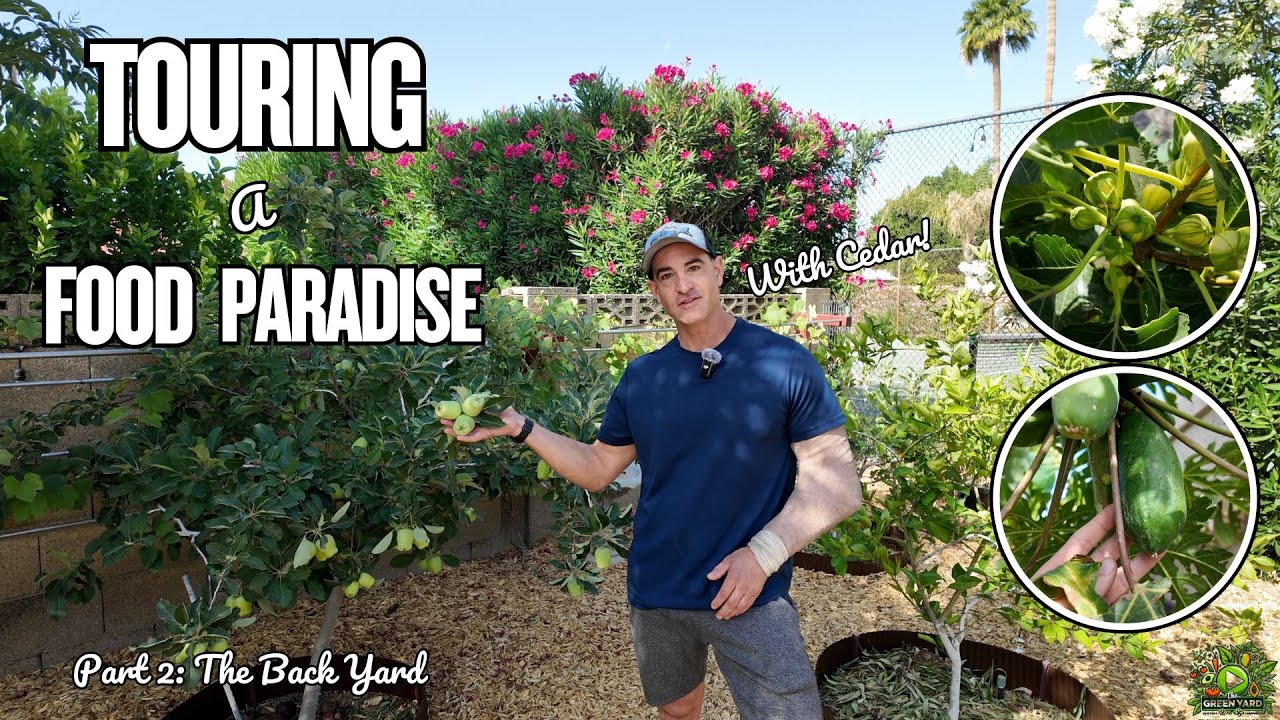
Phoenix Food Forest Tour: 24 Fruit Trees in a Tiny Backyard
Arizona
Phoenix
Food Forest Tours
Tropical Fruit
Small Space Gardening
Edible Landscaping
Tour Kim’s small Phoenix backyard food forest, where 24 fruit trees, tropical plants, edible landscaping, shade strategies, and creative microclimates create surprising abundance in limited space.
Author
The Green Yard
Published
August 28, 2026
Modified
August 28, 2026
Keywords
Phoenix food forest, Arizona food forest, small backyard food forest, Phoenix fruit trees, tropical fruit Phoenix, edible landscaping Phoenix, small space gardening, backyard orchard Arizona, Phoenix tropical garden, fruit trees Arizona
24 Fruit Trees in a Tiny Phoenix Backyard Food Forest
Tour Kim’s compact Phoenix food forest, where fruit trees, tropical plants,
flowers, groundcovers, shade plants, and a backyard pond are packed into a
surprisingly small residential growing space.
HostKim
PublishedAugust 28, 2026
Kim’s Phoenix garden is proof that an abundant edible landscape does not
require a huge property. Despite having only about 110 feet by 11 feet of
plantable space, she has managed to fit 24 fruit trees into the property while
also growing tropical ornamentals, vines, flowering plants, edible
groundcovers, and support plants. The result is a constantly evolving
small-space food forest shaped around Phoenix heat, afternoon shade, wind,
limited room, and the plants Kim simply enjoys growing.
GardenKim’s Food Forest
HostKim
LocationNorthwest Phoenix, Arizona
ClimateHot Sonoran Desert
Fruit Trees24 Trees
Plantable SpaceAbout 110 × 11 Feet
Property TypeSmall Residential Food Forest
Primary FocusMaximum Diversity in Limited Space
Inside a Tiny Phoenix Food Forest
Kim’s garden is built around one major limitation: space. The property is a
corner lot, the backyard includes a large swimming pool, and much of the
remaining plantable area consists of relatively narrow strips around the home.
Instead of treating that as a reason to keep the landscape simple, Kim has
used nearly every available pocket to grow something.
Fruit trees are tucked beside walls, near the pool, along the sides of the
house, around the pond, and into the front yard. Containers add another layer
where planting directly in the ground is not practical. Tropical ornamentals,
flowering shrubs, vines, edible groundcovers, and temporary shade plants fill
the spaces between the permanent trees.
The biggest surprise comes near the end of the tour, when Kim counts 24 fruit
trees on the property. That number becomes even more impressive when she
estimates that the usable planting area is only about 110 feet long by 11 feet
wide. This is not abundance created by owning more land. It is abundance
created by continually finding better ways to use the land that is available.
What You’ll Learn From Kim’s Phoenix Food Forest
How Kim fits 24 fruit trees into a property with only about
110 × 11 feet of practical planting space
Why the east side of a Phoenix home can become valuable growing space
for tropical plants that benefit from afternoon shade
How pruning and intentionally keeping trees small can make a dense
backyard orchard easier to manage
How seasonal vines, castor bean, bamboo, and permanent trees can all
contribute to summer shade and microclimates
How Kim uses plants for multiple purposes, including fruit, privacy,
shade, soil cover, flowers, and pollinator habitat
Why a productive garden can still be a work in progress, with trees
recovering, being moved, replaced, or redesigned as the gardener changes
Two Highlights From Kim’s Phoenix Food Forest
This TINY Phoenix Backyard Is FULL of Abundance!
Kim has a very small growing space in northwest Phoenix, but she’s
packed it with an incredible amount of abundance. See how the
limitations of a small property shape what she grows and the choices
she makes.
Have You Ever Heard of a Limequat?
Meet one of Kim’s favorite fruit trees: the limequat. She keeps this
naturally larger tree compact and enjoys the fruit straight from the
tree, where an aromatic, oil-rich peel balances the tart interior.
Designing Around Phoenix Heat and Afternoon Sun
One of the most useful parts of Kim’s tour is seeing how differently she treats
each exposure around the house. Her corner lot receives intense sun and wind,
and the western exposure can be especially difficult. The east side, however,
becomes a valuable microclimate because the house begins shading it during the
hottest part of summer afternoons.
Kim uses that protected side for many of her more tropical plants. The goal is
not to eliminate Arizona heat, but to control when the plants receive it.
Morning sun can provide plenty of light while afternoon shade reduces the
intensity of the hottest June, July, and August conditions.
She also creates temporary shade rather than relying only on permanent
structures. Fast-growing castor bean can provide seasonal protection. Vines
cover the pergola during summer, shading mango trees below, and can then be
removed when winter arrives so those same trees receive more sun.
Bamboo on the west side of the pergola adds another layer of protection,
blocking late-afternoon sunlight that could still reach the mangoes after the
overhead shade was in place. The garden shows how a small property can contain
many different microclimates simply by paying attention to walls, structures,
sun angles, and neighboring plants.
Keeping Fruit Trees Small on Purpose
A collection of 24 fruit trees would be difficult to maintain in this amount
of space if every tree were allowed to reach its natural mature size. Kim
instead treats pruning as part of the design. Several trees are deliberately
kept compact so they remain compatible with the house, pool, walkways, and
neighboring plants.
Her Pakistan mulberry is a good example of what happens when a vigorous tree
outgrows the role available to it. Kim has repeatedly removed several feet of
growth, yet the tree continues expanding rapidly. During the tour she explains
that it may ultimately need to leave because it simply wants more space than
the property can comfortably provide.
Other trees fit the system better when kept small. The limequat can be pruned
within reach. White sapote, guava, citrus, Barbados cherry, mango, and other
fruit trees are managed at a scale that makes sense for a residential yard.
The goal is not to see how large each tree can become. It is to keep many
different trees productive within the same limited landscape.
Growing Diversity in a Small Phoenix Backyard
Kim’s collection shows how much variety can fit into a small residential
landscape when every planting area is used intentionally. Mangoes, limequat,
longan, starfruit, white sapote, guavas, citrus, Barbados cherry, peach,
mulberry, papaya, and other fruit trees occupy narrow strips beside the house,
the front yard, and spaces around the backyard.
Many plants also serve more than one purpose. Fruit trees can shade the house,
bamboo and seasonal vines protect tropical plants from intense afternoon sun,
sweet potato covers exposed soil, and flowering plants add beauty and
pollinator habitat. The pond, which grew larger as Kim discovered how much she
enjoyed it, now provides a focal point and nutrient-rich water for nearby
mangoes.
Kim also describes the property as a “recovery yard.” Some plants declined
during a period when the garden received less attention, and several are now
recovering or being reconsidered. That ongoing process is part of the story:
the food forest continues to change as Kim learns which plants, locations, and
design choices work best for her limited Phoenix space.
Plants Growing in Kim’s Phoenix Food Forest
Kim’s small property contains an unusually broad collection of fruit trees,
tropical ornamentals, flowering plants, vines, groundcovers, and support
plants. Some are permanent parts of the food forest, while others are used
temporarily for shade or are still being evaluated as the garden evolves.
Growing StyleCompact, diverse and continually evolving
Featured Plants
MangoLimequatLonganStarfruitWhite guavaRedlands white sapoteFlorida Prince peachBarbados cherry
Show Complete Plant List
Hide Complete Plant List
Fruit Trees and Edible Plants
Green Indian jujube
Mango
Carrie mango
Sumo orange
Surinam cherry
June plum
Ice cream bean
Pakistan mulberry
Guava berry
Meiwa kumquat
White guava
Limequat
Longan
Cara Cara orange
Papaya
Sweet potato
Chaya spinach
Starfruit
Tango mandarin
Banana
Fukushu kumquat
Redlands white sapote
Florida Prince peach
Barbados cherry
Ruby Supreme guava
Lemon
Tropical and Ornamental Plants
Royal poinciana
Plumeria
Monstera
Natal plum
Cassia fistula, or golden shower tree
Morning glory bush
Sweet almond bush
Heliconia
Snow Queen hibiscus
Tropical hibiscus
Singapore dwarf plumeria
Madagascar rubber vine
Star jasmine
Vietnamese Turk’s cap hibiscus
Elephant food
Four o’clocks
Wisteria
Shade, Pollinator, and Support Plants
Tropical milkweed
Castor bean
Bamboo
Seasonal pergola vines
Sweet potato groundcover
The Green Yard Takeaway
Kim’s garden demonstrates that abundance is not simply a matter of owning more
land. With roughly 110 feet by 11 feet of plantable space, she has managed to
fit 24 fruit trees into the property while still making room for tropical
plants, flowers, vines, groundcovers, a swimming pool, and a pond.
The bigger lesson is how she uses that limited space. Trees are kept small,
afternoon shade is treated as a resource, temporary plants create seasonal
microclimates, and individual plants often perform several jobs at once. Even
the parts of the garden that are recovering or changing become part of the
story. Kim’s yard shows that a small edible landscape can still hold enormous
diversity when the gardener is willing to experiment and continually adapt.
Watch More From Kim’s Phoenix Food Forest
The full tour and two short highlights document how Kim uses limited space,
shade, pruning, and plant diversity to build an abundant edible landscape in
Phoenix.
Continue exploring how another Arizona grower uses shade,
microclimates, irrigation, and plant selection to create an abundant
edible landscape in the Sonoran Desert.