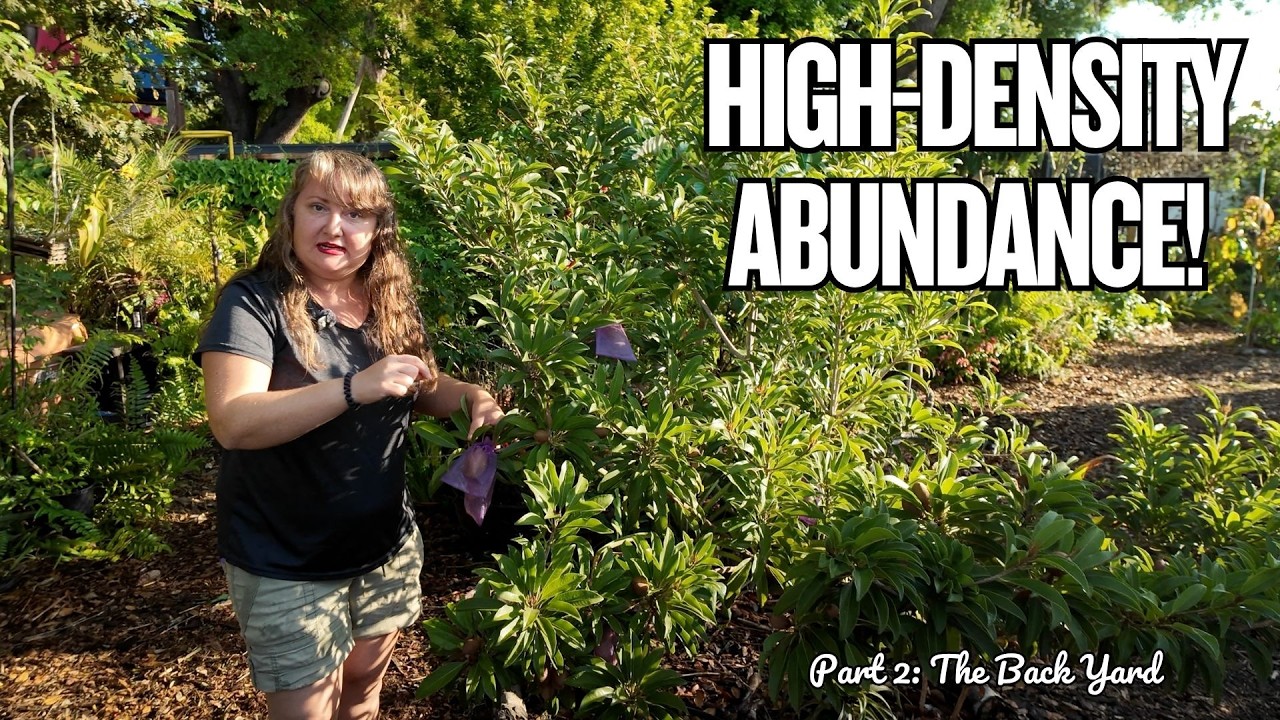
The Only Pomegranate That Grows in Tampa
KC explains why Vietnamese Red pomegranate succeeds where traditional varieties struggle with Tampa’s limited chill hours.
Tampa food forest, Gonza Gardens, Florida food forest, high-density food forest, front yard food forest, Tampa tropical fruit garden, tropical fruit trees, edible landscaping, USDA Zone 10A, Florida tropical gardening
Tour the front yard of Gonza Gardens, a high-density Tampa food forest where KC and her husband grow more than 100 fruit trees on only 0.17 acre in USDA Zone 10A.
In Part 1 of our visit to Gonza Gardens, KC guides us through a front-yard tropical food forest in Tampa, Florida. The property combines more than 100 fruit trees, perennial vegetables, fragrant ornamentals, native host plants, pollinator habitat, and medicinal plants within just 0.17 acre.
Gonza Gardens demonstrates how a relatively small residential property can support an extraordinary amount of edible diversity. KC and her husband grow more than 100 fruit trees on approximately 0.17 acre while still incorporating pathways, ornamental plants, wildlife habitat, propagation areas, and places for the family to use the yard.
The front yard is not arranged like a conventional orchard. Trees are selected and positioned according to their mature size, vigor, growth habit, cold tolerance, water requirements, and role within the canopy. Some plants are trained upward, others are kept columnar, and vines are espaliered along fences to use vertical space.
The garden originally began as an ornamental landscape before much of it was converted into a food forest. That history remains visible in the fragrant flowers and colorful foliage growing among mangoes, avocados, mulberries, sapodillas, perennial vegetables, herbs, and native butterfly host plants.
KC explains why Vietnamese Red pomegranate succeeds where traditional varieties struggle with Tampa’s limited chill hours.
Thoughtful placement, canopy protection, and the warmth of the house help sensitive tropical plants survive damaging cold.
Orange Sherbet mango stood out after a historic freeze damaged many of the other mango trees growing throughout the property.
Peanut butter fruit and blackberry jam fruit grow on opposite sides of the garden, creating a playful homegrown combination.
KC and her husband use pruning, layering, and careful spacing to grow more than 100 fruit trees on only 0.17 acre.
The tour took place after a damaging winter freeze affected many of the tropical trees. Mangoes and jackfruit showed substantial damage, while the Orange Sherbet mango remained especially resilient. More sensitive plants, including soursop, received temporary greenhouse covers and thermostatically controlled heat.
Protection begins with the original food forest design. Sensitive trees are placed on the south side of the house and maintained near the height of the building, allowing cold north winds to travel over them. Larger plants and upper-canopy trees also help shelter cacao, coffee, breadfruit, Cecropia, and other tropical species growing below.
Not every tree can be enclosed or heated in a densely planted garden. The larger strategy is therefore to combine thoughtful placement, canopy layers, pruning, and selective protection so the landscape works as a connected system.
Many familiar temperate fruits and vegetables are difficult to grow consistently in Tampa. Traditional cherries, apricots, apples, pomegranates, lettuce, tomatoes, and cucumbers may struggle with heat, humidity, disease, pests, or insufficient winter chill.
Gonza Gardens instead includes tropical and subtropical plants that fill similar roles. Barbados cherry provides a cherry-like fruit rich in vitamin C. Jujube can serve as an apple alternative. Vietnamese Red pomegranate fruits despite limited chill, while tindora produces small cucumber-like fruit and edible leaves through much of the year.
Perennial greens such as katuk, longevity spinach, and Okinawa spinach also reduce the need to repeatedly grow heat-sensitive lettuce. The garden’s productivity comes partly from choosing crops adapted to the climate rather than continually forcing unsuitable plants to survive.
High-density growing requires more than planting trees close together. KC considers the vigor and mature growth habit of each cultivar before choosing its position. Florigon mango is allowed to occupy more of the upper canopy, while compact cultivars such as Honey Kiss remain smaller and easier to prune.
Avocados are maintained in a narrow, columnar shape at approximately ten feet tall. Blackberries are trained horizontally along the fence, while sugarcane forms a productive living screen. Mulberries are pruned frequently, which can stimulate repeated flowering on everbearing varieties and keep fruit within reach.
Water requirements also influence placement. Bananas failed in a dry front-yard location despite thick mulch, but Namwa banana became productive when planted where roof runoff travels through a French drain. That single plant can receive supplemental water from the existing landscape instead of depending entirely on irrigation.
Edible plants share the garden with native host plants, fragrant flowers, and ornamentals selected for wildlife. Corky-stem passion vine supports Gulf fritillary and zebra longwing butterflies, while Dutchman’s pipe supports Polydamas and pipevine swallowtails.
Amistad salvia, native red salvia, porterweed, blue sky vine, bougainvillea, Senna alata, sweet almond, and other flowering plants provide nectar, fragrance, color, and extended bloom periods. Coontie also serves as a host plant for the atala butterfly.
The result is a food forest that produces for people while also providing habitat for butterflies, caterpillars, hummingbirds, bees, and other wildlife throughout the property.
This portion of Gonza Gardens includes tropical fruit trees, named cultivars, perennial vegetables, medicinal plants, spices, native species, butterfly host plants, flowering ornamentals, and support plants adapted to Tampa’s USDA Zone 10A climate.
Gonza Gardens shows that the number of acres available matters less than how thoughtfully the space is designed. More than 100 fruit trees can grow on 0.17 acre because plants are selected for their size, trained to use vertical space, pruned to remain manageable, and positioned according to their individual needs.
The front yard also demonstrates the value of adapting to the local climate. Tropical substitutes replace temperate crops that struggle in Tampa, while roof runoff, canopy protection, native host plants, and perennial vegetables allow the landscape to become more productive and resilient over time.
KC and her family also operate Food Forest Finds, an edible plant nursery specializing in plants that have performed well in their own Tampa food forest. Many plants are propagated directly from material growing on the property.