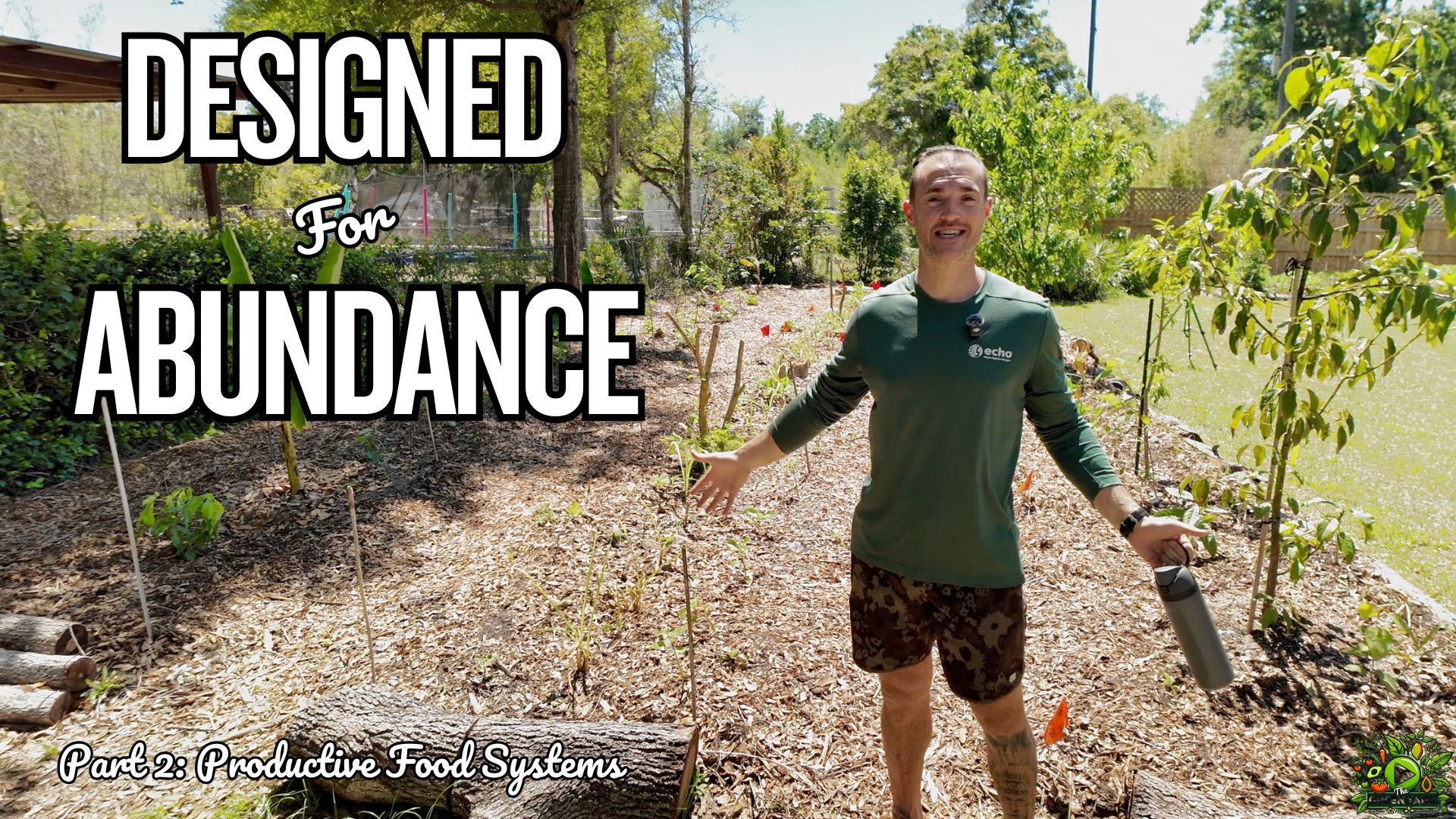
Grow Your Own Fertilizer With Chop and Drop
Ryan uses fast-growing support plants to create mulch, green manure, shade, and nutrients directly inside the food forest.
Central Florida food forest, Food Forest Florida, Florida agroforestry, syntropic agriculture, Grocery Row Garden, chop and drop, Florida fruit trees, cold tolerant avocado, tropical fruit trees, Florida permaculture, rainwater harvesting, mango orchard
Tour Ryan’s productive Central Florida food forest and explore syntropic planting, Grocery Row gardening, chop-and-drop fertility, cold-tolerant fruit trees, rainwater harvesting, container growing, and a diverse mango orchard.
In Part 2 of our visit to Food Forest Florida, Ryan guides us through several productive growing systems designed for Central Florida. The tour includes a young syntropic garden, a Grocery Row Garden, biomass production, cold-tolerant avocados, low-chill fruit trees, container fruit, rainwater collection, a pineapple island, and a diverse mango orchard recovering from a winter freeze.
Ryan’s property contains several different growing systems, each designed to test practical ways of producing food in Central Florida. Some areas are planted with established named fruit varieties, while others are filled with inexpensive seedlings, rooted cuttings, bananas, nitrogen-fixing trees, and fast-growing biomass plants.
The systems are designed to do more than simply hold fruit trees. Support plants create shade, protect sensitive crops from Florida’s intense sun, reduce moisture loss, produce organic material, and help build fertility directly within the landscape.
Instead of purchasing every input, Ryan is working toward a system that produces its own mulch and green manure. Mexican sunflower, vetiver, bananas, eucalyptus, nitrogen-fixing trees, and fast-growing grasses are repeatedly cut and returned to the soil around productive fruit trees.
Ryan uses fast-growing support plants to create mulch, green manure, shade, and nutrients directly inside the food forest.
Silas Woods sapodilla remained productive through the freeze and produces sweet fruit with a rich brown-sugar flavor.
Two productive tree rows surround a central biomass row that continually produces organic material for the fruit trees.
Container-grown mangoes, apples, and avocados can remain productive while still being moved when freezing weather arrives.
Ryan's newest planting area is inspired by syntropic agriculture, a style of agroforestry that focuses on producing fertility directly inside the garden. Rather than relying primarily on purchased compost or fertilizer, the system grows fast-growing support species whose biomass is continually recycled back into the soil.
Nitrogen-fixing trees such as Enterolobium establish the future canopy, while Mexican sunflower, vetiver grass, bananas, and other rapid-growing plants provide a continual supply of organic material. These plants are repeatedly cut and returned to the soil through chop-and-drop, helping retain moisture, feed soil biology, reduce weed pressure, and gradually improve fertility.
Ryan also incorporates perennial vegetables and understory species beneath the developing canopy so the garden begins producing food long before the larger trees reach maturity. The result is a system where every layer serves multiple purposes—from food production to shade, mulch, pollinator support, and nutrient cycling.
One of Ryan's signature projects is the Grocery Row Garden, adapted from David the Good's design. The concept is simple: two rows of productive fruit trees surround a center row dedicated almost entirely to biomass production.
Rather than planting another row of fruit trees, the middle bed grows species whose primary purpose is producing organic matter. Fast-growing grasses and chop-and-drop plants are harvested multiple times each year and spread beneath the surrounding fruit trees as green manure. This continually feeds the system while reducing dependence on outside inputs.
Ryan begins new Grocery Row plantings by loosening compacted soil a single time, adding compost to quickly reintroduce soil biology, and covering everything with deep wood chips. Once established, biomass plants become the primary source of fertility for the surrounding orchard.
Another theme throughout the property is extending harvest windows. Instead of planting only one avocado or loquat variety, Ryan selects multiple cultivars that ripen at different times. Winter Mexican, Mexicola Grande, and Brogdon avocados together can provide fruit over much of the year, while carefully selected loquat cultivars extend the spring harvest beyond a single short season.
Many additional trees are grown from seed as long-term experiments. Some will eventually be grafted with improved varieties, while others may prove to be worthwhile selections on their own. Seedlings also provide inexpensive rootstock for future propagation.
This willingness to experiment allows the property to function as both a productive food forest and an ongoing learning laboratory.
Not every fruit tree grows in the ground. Ryan intentionally keeps certain mangoes, apples, and avocados in large containers so they can be moved during freezing weather.
Low-chill apple varieties such as Anna and Dorsett Golden continue to produce successfully in pots, while compact mango cultivars including Honey Kiss and Pickering remain portable enough to protect when necessary. Even Wurtz avocado can remain productive in containers for many years with proper care.
Container growing gives gardeners an opportunity to expand the number of species they can grow while reducing the risk associated with occasional Florida freezes.
The agroforestry systems include named fruit cultivars, seedling experiments, nitrogen-fixing support trees, perennial vegetables, biomass crops, tropical fruit, and low-chill temperate species working together as an integrated food production system.
Ryan’s property shows that productive agroforestry is not only about growing more fruit trees. The larger goal is to design a system where shade, mulch, fertility, water, protection, propagation, and food production reinforce one another.
The most important lesson is Ryan’s effort to grow many of his own inputs. Fast-growing grasses, nitrogen-fixing trees, bananas, Mexican sunflower, vetiver, and other support plants produce material that can be cut and returned directly to the soil. Over time, this can reduce dependence on purchased fertilizer while improving moisture retention and soil health.
The property also demonstrates the value of diversity. Cold-tolerant avocados, low-chill temperate fruit, tropical species, container-grown trees, seedlings, grafted cultivars, rainwater storage, and multiple planting systems create several different paths to productivity within the same Central Florida landscape.
Ryan shares more of his Central Florida growing experiments through Food Forest Florida, including agroforestry systems, tropical fruit, propagation, freeze recovery, and practical strategies for building a productive landscape.